

This was a question I recently had to answer after somebody had heard over the radio that Klerksdorp made the claim to be the oldest town in the old Transvaal. The debate about which town would be the oldest one across the Vaal River had been going on for many decades and even caused two local, noteworthy experts on local history to come to loggerheads.
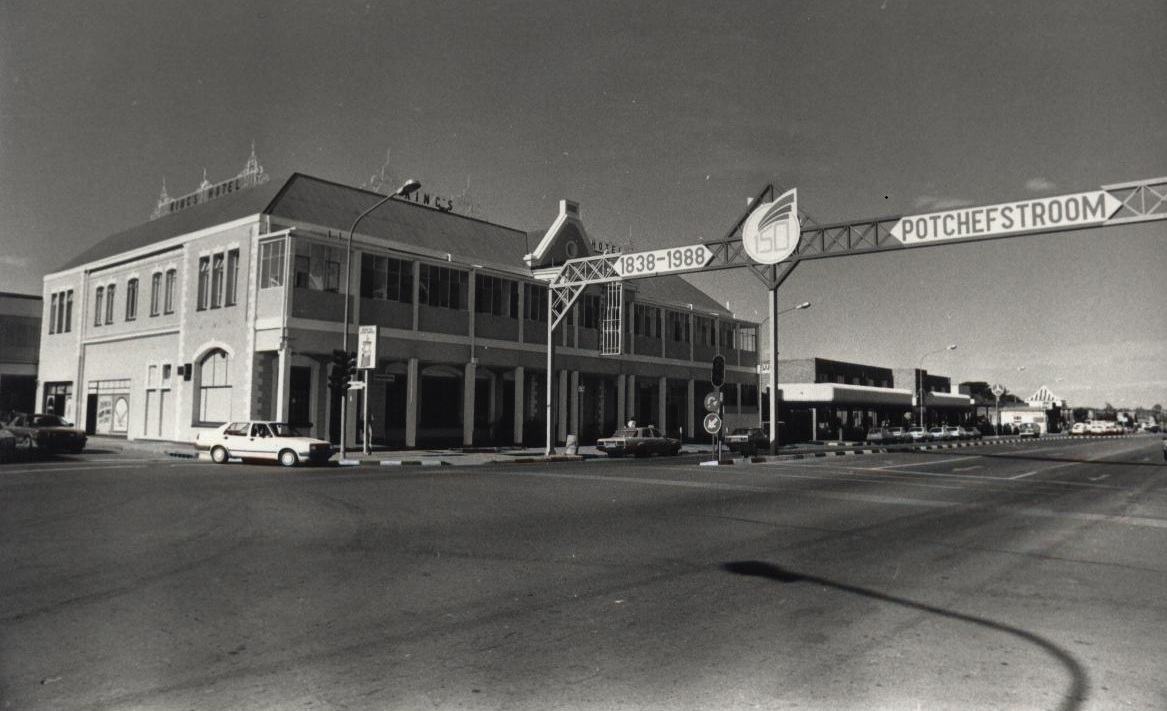
To let all visitors know that the town is celebrating its 150th anniversary, a triumphal arch was placed over the then Potgieter Street (Nelson Mandela) in front of the King’s Hotel.
Prof Gert van den Bergh had been commissioned to chronicle the history of Potchefstroom, one of the many projects that was launched to celebrate the 150th anniversary of Potchefstroom in 1988. Extensive 150th centenary festivities had been planned for 1988, many years in advance. The motto chosen for the town for its centenary year was: “From first town to future city.”
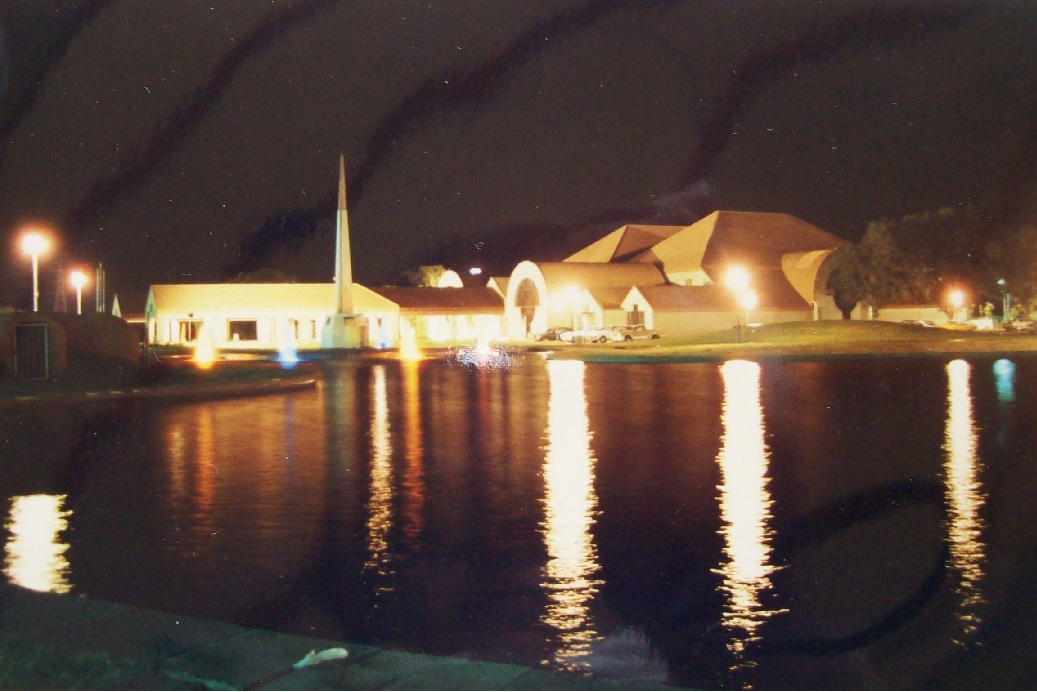
One of the highlights of the 150th celebrations in 1988, was the opening of the Andries Hendrik Potgieter Banqueting Halls, now the Madiba Banqueting Halls. Photo: NWU Records, Archives and Museums
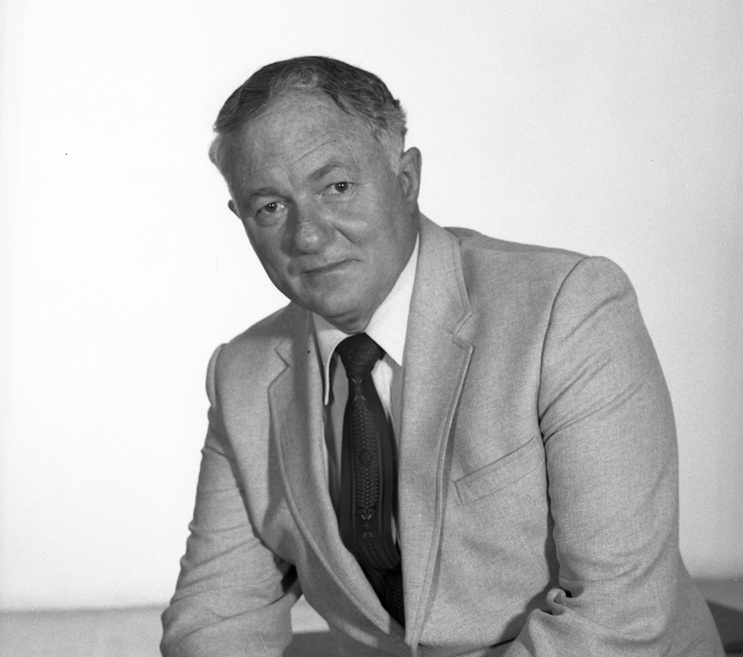
Prof Gert van den Bergh, who was commissioned to chronicle the history of Potchefstroom as a part of the 150th celebrations in 1988. Photo: NWU Records, Archive and Museums
In the meantime, Klerksdorp celebrated its 150th year in 1987, making the statement that it was the oldest.
Who is correct?
Prof Van den Bergh said: “about the exact date when Potchefstroom was founded, much has been written, debated and quibbled.”
The Herald described the founding in its Supplement to celebrate the 150th anniversary of Potchefstroom as such:
The Mooi River area was not unknown to (Andries Hendrik) Potgieter when he founded the settlement. It was discovered by the Voortrekkers by 1836 and also visited later in a commando against Mzilikazi.
The beautiful stream of clear water and the fertile ground already drew Potgieter’s attention at an early stage, hence the founding of the first Voortrekker town on the banks of the Mooi River
No documentary proof could be found that could with absolute certainty determine the founding date and the dates that have since been put forth by historians are vague and divergent. Three of the most important historians and researchers of the Voortrekker history put the founding of the town in November 1838.
The Herald consulted a book that was compiled in 1938 with the centenary of Potchefstroom.
This source also mentioned that many contemporary authors attributed the founding date of Potchefstroom to 1838.
One of the contributors to the 1938 publication was Prof J Chr Coetzee, who wrote the section about the history of education in Potchefstroom for this book. He later became the Rector of the Potchefstroom University for Christian Higher Education (PU for CHE).
He wrote that the founding date of 22 December 1838 is generally accepted. This is according to a report that appeared in The Natal Advertiser in 1921: “Old Mr Barent Swart, of Klerksdorp, furnished me many years ago with . . . an exact date of its founding. His words were: ‘Oudedorp was proclaimed a dorp (town) on December 22, 1838.”
For Potchefstroom, thus to claim 1838 as its founding year, was done by a very narrow margin!
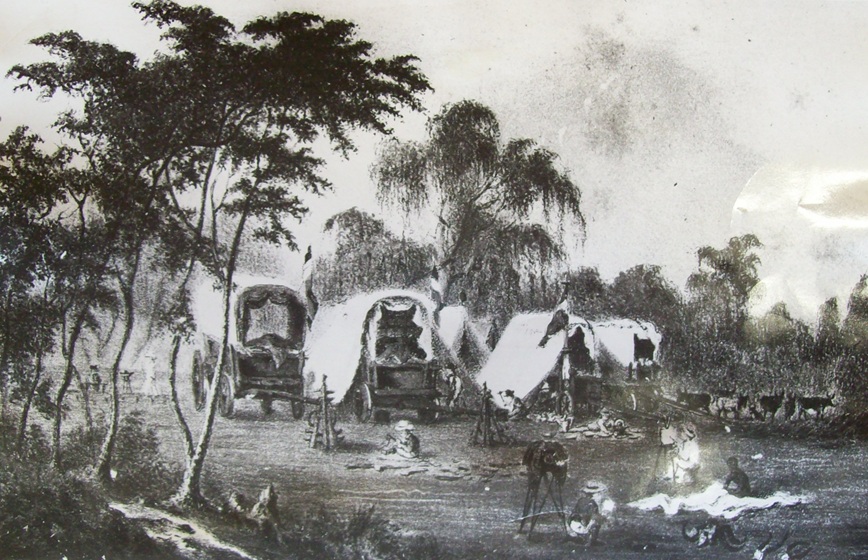
An early depiction of Potchefstroom, probably at Oudedorp, where the Voortrekkers first settled after arriving in the area and proclaimed the town, Potchefstroom. Photo: Potchefstroom Museum
Bomb dropped
Anticipation for the festivities reached fever pitch at the beginning of 1988.
During a Groot Trek Conference that was held in Potchefstroom in January 1988, Prof Piet van der Schyff figuratively speaking dropped a bomb!
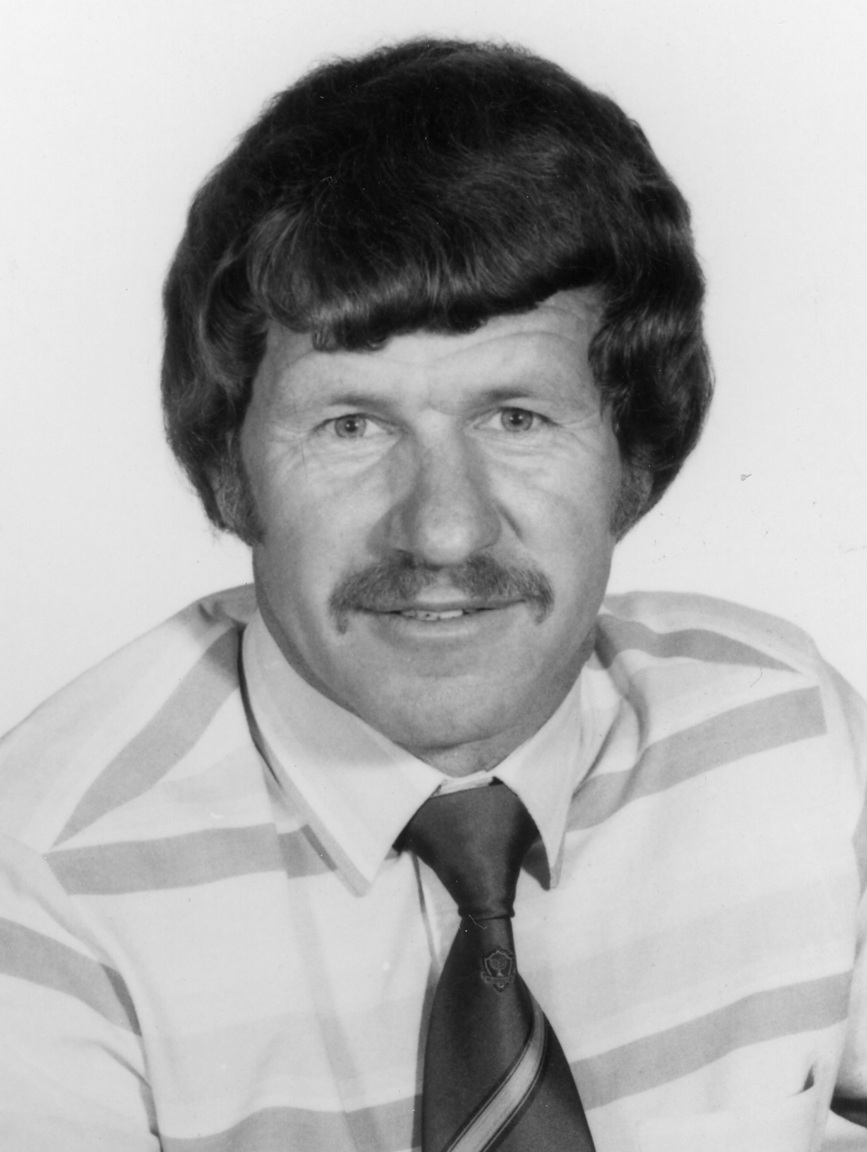
Prof Piet van der Schyff who claimed that the 1988 celebrations were a year too early. Photo: NWU Records, Archive and Museums
He was of the opinion that the founding date of Potchefstroom was June 1839, not 1838! He came to this conclusion after consulting the farm registers that were started after the Voortrekkers settled in the Northern Orange Freestate and the Transvaal.
The only farms allocated during 1838 was south of the Vaal River, thus in the Freestate. The first farms that Chief Commander AH Potgieter registered in the “District Mooiriver” were on 3 June 1839.
Apart from this, Prof Van der Schyff also accepted the 1839 founding date after he came to the conclusion that it appeared “preposterous” that the settlement would exist for five months before the registration of farms commenced.
He also said that his findings concur with a memorandum that Prof Van den Bergh presented to the city council in 1987.
Apart from this, he asked the question if Oudedorp was ever a town in the true sense of the word with a magistrate, erven and a church as distinctive features?
He acknowledged that there were many ambiguous aspects that had to be clarified before any conclusion could be made.
These allegations were definitely not welcome news for the city councillors of Potchefstroom who have invested a lot of money and many manhours in the planning of the 1988 festivities.
On 4 February 1988, Prof Van den Bergh replied in a letter to Herald in which he confirmed that he came to the conclusion that Potchefstroom was founded in 1838. He said that the “new sources” that Prof Van der Schyff quoted, namely the farm registers, were not new at all. He also does not accept his colleague’s point of view that it is “preposterous” to accept that the settlement was five months old before the first farms were first registered.
On 9 February, Prof Van der Schyff retaliated with an equally long letter.
Almost like two kudu bulls these two local historical experts – and colleagues in the Department of History at the PU for CHE – were butting heads about the founding date of Potchefstroom and neither one was willing to stand off. This only came to an end when the authorities of the PU for CHE intervened and ordered them to end their disagreement.
“Ore” had something to say
The editor of the Herald, at the time, Hennie Stander, was the author of a column in the Herald, called “Ore sê” (Ears speaks), which at the time, he wrote anonymously.
Ore was watching this skirmish from the sidelines and wrote: Ore sees these two learned professors that had this thing going on about the age of Potchefstroom, have not finished. The one said the centenary celebrations are done at the right time and the other one said it is too early.
Ore just wants to make a remark – if this was a braai and the meat was marinated, the fires started and the ice was in the bucket and the guests started to arrive – Ore would have held his braai, even it was an evening too early.
What is strange to Ore, is that the city council has not yet answered the guy that is of the opinion the celebrations are early.
Wim Bosman, the artist who created the well-known cartoon series, Louis die Laeveld Leeu, at the time drew cartoons for the Herald and sketched two that depicted this fight.
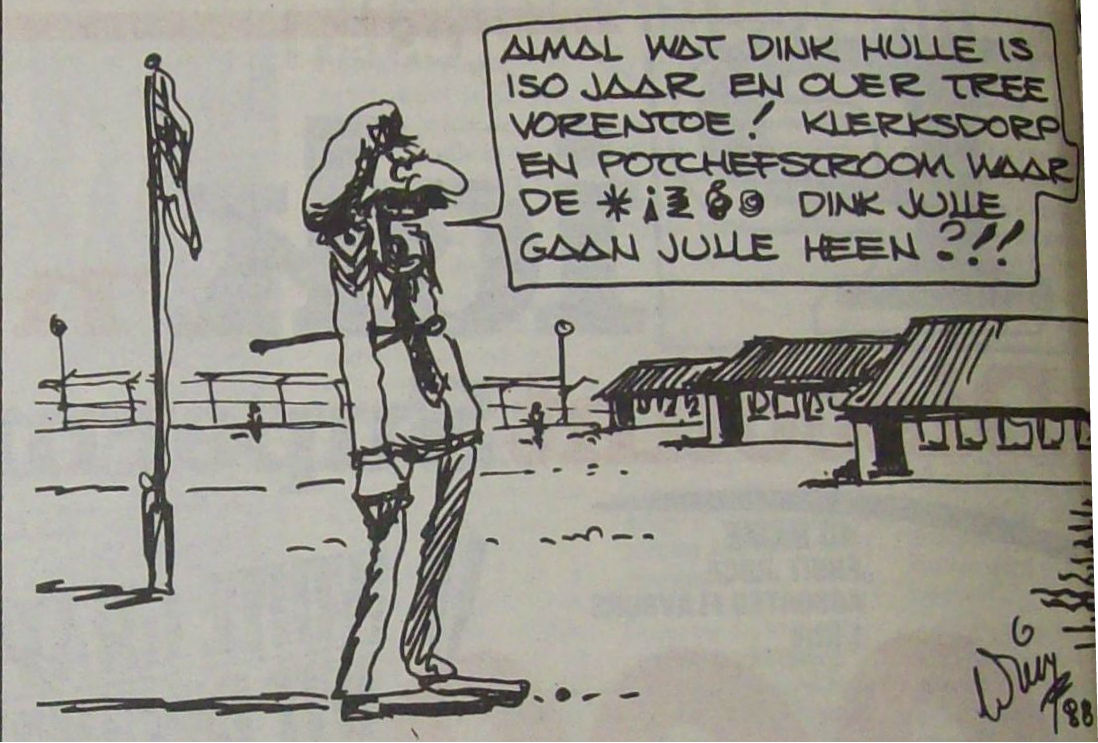
Wim Bosman drew this cartoon for the Herald that was published on 2 February 1988.
Stick to his guns
Neither one of the two professors were willing to stand down. In his unpublished study about the history of Potchefstroom, that was completed ten years later, in 1998, Prof Van den Bergh still accepted the founding date as 22 December 1838.
In the same manner, Prof Van der Schyff wrote in Mielieboersage, that was published in 1996: “During the 150th celebrations of Potchefstroom, that was held in 1988 (instead of 1989) . . .”
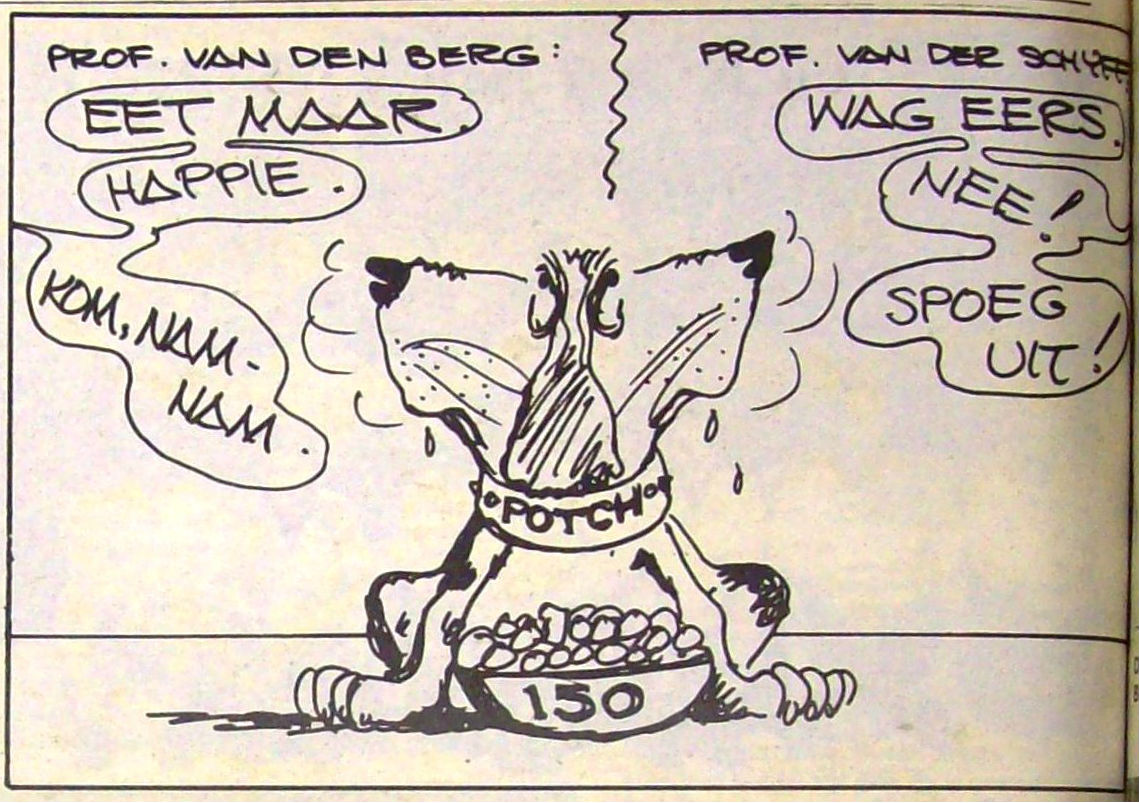
On 9 February 1988, the Herald published this cartoon by Wim Bosman.
What then about Klerksdorp?
Klerksdorp celebrated its 150th year in 1987. The city claimed that the first Voortrekkers settled on the banks of the Schoonspruit in 1837.
Prof Van den Bergh wrote in his letter to the Herald on 5 February 1988, that he and Prof Van der Schyff came to the same conclusion about Klerksdorp. It became a town in March or April 1839.
The long and the short is that Klerksdorp was the first settlement of Voortrekkers across the Vaal River, but Potchefstroom was the first town.
As far as the matter of the farm registers only being started in June 1839, it must be noted that Potgieter was always planning to move further north to get as far away from English rule as possible. He believed that the English would not cross the 25th latitude. By 1845 he left Potchefstroom and trekked north to found Ohrigstad.
The reason his trek came to a halt in Potchefstroom was due to the fact that he was en route to Louis Tregardt, but due to activities of the local Matabele in the area he could not move further north.
He also needed an official address from where he could discharge his official duties as ruler or governor, hence, the early declaration of the town. This, in a sense, also explains the composition of the name “Potchefstroom”. It is generally accepted that the “Pot” comes from Potgieter, “chef” because he was the leader or “chief” and the “stroom” from the Mooi River.
However, the fertile area along the banks of the Mooi River was alluring to many of his company who decided to stay here. This might be an explanation why the farm registers were only started months after the Voortrekkers arrived here.
To conclude, Potchefstroom is the oldest officially declared town north of the Vaal River and Klerksdorp the first settlement.
SELECTED SOURCES:
Van den Bergh, G.N., Die geskiedenis van Potchefstroom, Potchefstroom, 1988, ongepubliseer.
Van den Bergh, G.N., Vrae oor die eerste Potchefstroom, 1839-1842, Suid-Afrikaanse Tydskrif vir Kultuurgeskiedenis, 1992, p. 104.
Van der Walt (red.), A.J. Potchefstroom 1838-1938, Johannesburg: 1939.
