

This article is dedicated to Mr Richard Bate, great-grandson of CV Bate, who resides in the United Kingdom and who contacted me in November 2025 with a request for information on his great-grandfather. He, however, provided me with information that I have been wanting to know since I started researching the history of the Herald, and Mr Bate 19 years ago.
From time to time a forward-thinker steps into history, changes his world and many remember him. There are numerous figures known world-wide like this, but in every town and city there are forward-thinkers who made a difference to the course of the history of that town or city. Unfortunately, when those people step out of the spotlight, most people forget them.
Such a person was CV Bate, the founder of the newspaper, the Potchefstroom Herald. Eventually he owned the paper for almost half a century – amongst other business ventures.
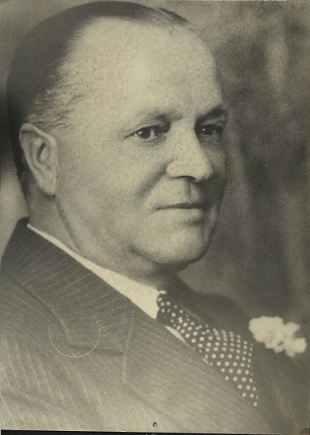
CV Bate (1877-1961) was the founder of the Potchefstroom Herald and owner for almost half a century. Photo: Potchefstroom Herald
When Bate came to Potchefstroom in 1902 he resumed to publish the Potchefstroom Budget, a newspaper of which the publication was suspended during the Anglo-Boer War.
His involvement in the War will be discussed below, but later he wrote: I was instinctively impelled to get back to my own profession of journalism and newspaper work generally. Among the newspaper opportunities offering I accepted a call to Potchefstroom and arrived here in October, 1902, to restart edit and manage the old Potchefstroom Budget.
I was full of youthful enthusiasm, and came to Potchefstroom looking for a newspaper world to conquer (Bate was 25 years old at the time), but my chagrin can perhaps be imagined when I entered into a most primitive condition of affairs which was in striking contrast to the modern facilities for production to which I had been accustomed during my early training in the English West Country.
This information came from An Editor’s Reminiscences – 36 years of newspaper work in the Transvaal, CV Bate’s autobiography. This was initially serialised in the Herald, but later privately published by Bate in a small volume of 36 pages.
He explained why this was published: In response to the request of numerous friends, therefore, I have been bold enough to reprint, in booklet form for private circulation, the little story of endeavour of storm and sunshine, contained in these experiences.
After a few months and many setbacks at the Potchefstroom Budget, Bate decided to accept the offer of Woolf Carlis to become the managing director of a new newspaper, The Western Transvaal Times. Carlis is better known for his involvement with the state irrigation scheme at Vyfhoek outside Potchefstroom. Although the newspaper was announced with much fanfare, it was not successful and lead to Bate being the co-defendant in a case in the High Court and had to refund Carlis with an amount of £3 000. “I did not even posses 3 000 shillings!” he later wrote.
He returned to the Potchefstroom Budget, but changed the name to the Western Chronicle.
By 1905 it appeared that in spite of the primitive conditions and setbacks, Bate started making a success.
A very private man
In early April 1905, on the eve of his wedding to Elizabath Jane Turpin, he hosted a dinner for the staff of the newspaper in celebration of his approaching marriage. This was noted in a small paragraph on 5 April 1905 in the Western Chronicle, that concluded: “a convivial time was spent.” The paragraph in the newspaper about this also mentioned: Reference was made to the manner on which the circulation and influence of the Chronicle had increased during the last twelve months, and the hope was expressed that the firm would continue to prosper.
Even from this paragraph which is probably one of the first that Bate published about his personal life, it became clear that he wrote many words, but little about himself since neither his future wife’s names or surname or the date of their wedding were mentioned. This “guarding of his privacy” was evident throughout his whole life. As stated above, it was only after being prompted by his friends that he published his memoirs.

Richard Bate still has his great-grandfather’s hair brushes. CV Bate was always a meticulously groomed man.
Not much is known about CV Bate apart from his professional accomplishments. In what was published about him and by him during his life time, his full names, Charles Veale Bate, were never used. He wrote and did business under the name CV Bate and in an appreciation that was written by Ernest Jenkins when he severed his ties with the Herald in 1957, the heading used the acronym he used, CeeVeeBee.
I was a young reporter at the Herald when the newspaper celebrated its 75th anniversary in 1983. A supplement was produced recording the history of the newspaper. Mrs Irma van Heerden (now Meyer) was the editor of this supplement, but all the reporters contributed. This meant that all of the newspapers published in the past three quarter of a century had to be perused to dig up its history.
Due to the foresight of Mr Bate and other like-minded individuals, an almost complete set of Heralds was preserved. By this time, it was in the possession of the Potchefstroom Museum, but was collected by the staff of the newspaper and the historically minded teachers of the Potchefstroom High School for Boys, who later donated their copies to the Museum.
Little did I know that 25 years later, when the centenary of the newspaper was approaching, I would be commissioned to compile the centenary supplement. This meant another deep dive into the history of the newspaper. I, fortunately, only had to acquaint myself with the newspapers of the last 25 years of the newspaper’s first century.
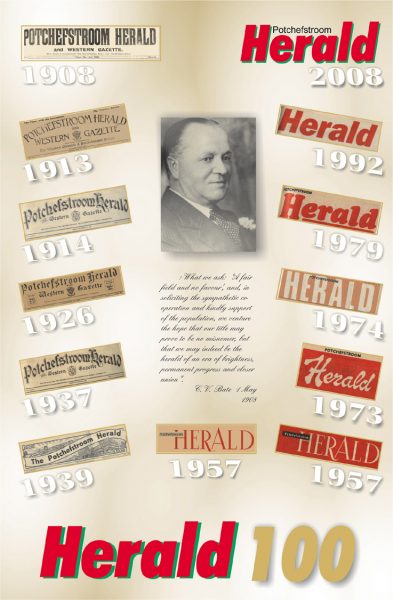
The front page of the centenary supplement of the Herald, published in 2008.
One of the pieces of information that I was not able to find in the millions of words in those newspapers, or any other research, was the full names of Mr Bate. Neither the editor at the time, Mr Hennie Stander, nor his predecessor, Willie Louw, knew. Me Irma Meyer consulted notes that she kept all those years, but also she did not know. The archives of the Potchefstroom Museum did not reveal the names, but Mrs Elmarie Weyers, curator of the Museum, advised me to visit the Potchefstroom Cemetery and consult the burial registers kept there.
After having difficulty in procuring an appointment with the cemetery manager, I eventually arrived at their offices very eager. A true Potchefstroom thunderstorm was building up and then erupted with lightning flashes and thunder over the small cemetery office. The office stands right next to the tall, typical cemetery-like, cypress trees, that looked very much like candidates to attract a lightning strike.
The burial registers consist of a separate book for each letter of the alphabet where the surname, name of the deceased, date of death, age at the time of death, church denomination, number of the burial plot, the name of the next of kin and last known address of the deceased were recorded. The size of each of these registers is at least 80 X 50 X 12 cm! Handling those were quite intimidating!
In the designated register for names starting with a “B” no entry existed for Mr Bate, apart from a note in the margin reading “CV Bate, D” and a number. After some head-scratching by the cemetery manager and myself, we figured out that we had to look in the register for names starting with a “D”.
And, lo and behold! There it was “Charles Veale Bate”. The cemetery official inadvertently entered his details under “D” and not “B”. In all the years of writing and researching history, that was one of my number one “Eureka!” moments.*
The Potchefstroom Herald founded
By 1908 Bate decided to found the Potchefstroom Herald. He wrote about this in his memoirs:
. . . and in 1908, for various reasons, I decided to branch out on my own. Bate failed to mention what those reasons were.
The opportunity came through the untimely death of The Potchefstroom News, a free paper for which the plant had been brought in and which was one of numerous opposing journalistic ventures which failed over a period of years. I purchased the plant from Mr Fred Coop, a photographer, and Mr. Collin Wade . . .
I had very little capital and I paid a small sum down and undertook to pay the balance by instalments. Incidentally, the cylinder machine then acquired was one on which The Star was originally printed, the press having been brought by ox-wagon from Grahamstown . . . when the Rand goldfields first came into being.

This is how the Wharfedale Press looked on which Bate first printed the Herald. The first edition of The Star, after being previously published in Grahamstown, saw the light in Johannesburg on 17 October 1877. In spite of the fact that Bate in 1939 mentioned donating the press to the Africana Museum in Johannesburg, this is, however, not in their collection anymore. This video shows a Wharfedale Press in action: https://www.youtube.com/watch?v=IDCfjh3RQnw
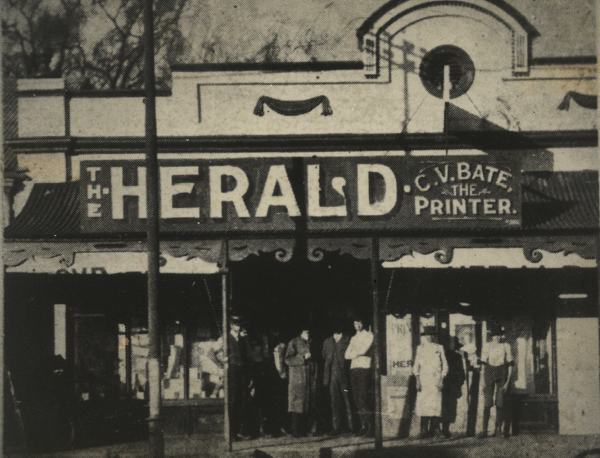
The original offices of the Herald were situated in Church Street (now Walter Sisulu Street, formerly King Edward Street). In An Editor’s Reminiscences (1938) Bate wrote about this photograph: A picture of the first Herald office, an old general store, shews our original small staff. Bate, who seemed to favour a flower in his buttonhole, might be standing on the far left. Photo: Potchefstroom Herald
One of the chief mechanical difficulties was that there was no electric current available in Potchefstroom, so that for some considerable time The Herald was printed by the primitive means of “man power”.

The first Potchefstroom Herald appeared on 1 May 1908. The size of the newspaper was about the same size as today’s daily newspapers, but slightly shorter. Only advertisements were printed on the front page. The editorial pages existed of seven columns and apart from a long introductory article reporting was mostly about everyday events: obituaries, military activities, sport, school news, the town council, farming and weddings.
Bate, who was the owner, printer and editor of the Herald, set out the purpose and policy statement of the new newspaper.
He ends the long article with the following words, which echo down the past 100 years, to be still true today: “What we ask: ‘A fair field and no favour’, and, in soliciting the sympathetic co-operation and kindly support of the population, we venture the hope that our title may prove to be no misnomer, but that we may indeed be the herald of an era of brightness, permanent progress and closer union”.
The Herald will be primarily a Potchefstroom newspaper, aiming at giving a reliable and impartial service of local news and offering such comment as it may humbly deem to be for the common weal. While reserving the right to criticise as freely as occasion may demand, we hope to maintain a strictly independent attitude, and to treat public affairs, whether parochial or colonial, without undue bias and from a non-party point of view …
The Herald wishes to be on the side of justice and integrity, and will strive to render public service by being outspoken at all times and pertinently critical whenever necessary. But our hitting, if hard, will, we trust, be clean, giving to those from whom we may be compelled to differ credit for convictions which are honestly held. It is in conflict with our ideas of journalism to let a newspaper descend to unreasonable or unprincipled motives which lie outside the region of legitimate criticism.
Bate also had to canvas for advertisements and recalled one business owner who said he had never advertised and never will!
The first years
The Herald, like anything new, suffered through a lot of growth pains. Bate wrote in his memoirs:
Newspaper work, even in a country town, holds a great fascination, and has many compensations, in spite of the envious, the grousers and the hypersensitive. There are those who are annoyed if their names do not appear in the social sense; there are those who bring pressure to keep their names out of print; often with a police court angle to it. There is, however, great joy in achievement …
The responsibilities of running a newspaper, however, was not – and still is not – by any means ‘roses, roses all the way’. There was a good deal of fun in it, but quite a leavening of worry and even unpleasantness.”
The first five editions published in the first month of the Herald’s existence raised the total revenue of £47! Apart from having to break new ground, his old newspaper the Western Chronicle was now his opposition. By 1912 the Chronicle had been declining for some time. Bate took it over and incorporated it into the Herald.
In spite of this he achieved some milestones: I set myself the task of collecting first-hand information from Voortrekkers and pioneers of the Old Capital, who were still alive, reminiscences of the early years of the settlement across the Vaal, and the building up of Potchefstroom as a commercial centre.
The first Christmas supplement was published on 18 December 1908. He explained:
The Herald at the end of 1908 broke new ground for Potchefstroom by publishing an illustrated Christmas number, printed in two colours, consisting of no fewer than ten pages, an effort that taxed the staff and plant to full capacity and necessitated day and night work for all. That effort gave us a great thrill.
The first time a second colour, apart from black, was used to print, was in this Christmas Edition. Apart from the masthead in red, a giant Father Christmas also appeared in red.

The red Father Christmas in the Christmas Edition. Photo: Herald
More firsts
The first photograph in the Herald appeared on 15 May 1908, in the third edition of the newspaper and was that of a football as part of an advertisement.
The first photograph that was included as part of the editorial section, was that of the mayor of Potchefstroom, Mr MA Goetz, and was published on 6 November 1908.
With the opening of the Town Hall in March 1909 the Herald published a Special Edition to commemorate this auspicious occasion. Bate’s thoroughness as a journalist is evident in this supplement which included everything that anyone would want to know about the occasion. He even noted that no designated area was made available for journalists who wanted to report on the event!

The opening of the new Town Hall merited a huge effort from the Herald. This photo page, in itself a huge accomplishment since the engraved metal plates for the photographs had to be made in Johannesburg. The photo at the top shows the new Town Hall. Below is the mayoress, Mrs Goetz and the mayor, MA Goetz. (See my article: https://lenniegouws.co.za/goetz-fleischack-museum-portraying-the-lifestyle-of-more-than-a-century-ago/ ) Below them are General Jan Smuts, the Colonial Secretary, who officiated at the opening and to the left, Mr Geo Warren the contractor. At the bottom is the new council chamber of the town council.
In 1912 Bate decided to publish a second edition each week which appeared on Tuesday. Declining economy during the depression years necessitated him to discontinue this edition in 1936.
A shocking murder that occurred on 31 December 1912 on the farm Wonderfontein near Oberholzer (now Carletonville) when a deranged wife nearly decapitated her husband, necessitated the publication of a special edition on 3 January 1913. Bate’s extensive reporting is again evident. See my article: https://lenniegouws.co.za/new-years-eve-murder/
First Englishman to publish a Dutch – later Afrikaans – newspaper
The political atmosphere during the years of the First World War prompted Bate to publish a Dutch, later Afrikaans, newspaper De Westelike Stem (later Die Westelike Stem). The first edition appeared on 12 August 1915. He later wrote about it: I was probably the only Englishman who had ever established and controlled a “Dutch” newspaper in South Africa – a fact of which I shall always be very proud – and in spite of prejudice Die Westelike Stem became a force in the political world of the Western Transvaal.
By 1925 he appointed a new editor, Ernest Jenkins, who served the Herald until 1959, even after Bate’s tenure. Apart from the fact that Jenkins himself contributed to a publication, in 1939, which celebrated the centenary of Potchefstroom, his son Geoffrey, then a matriculant at the Potchefstroom High School for Boys wrote A Century of history – The story of Potchefstroom, also about the history of Potchefstroom.
In 1925 the Prince of Wales visited Potchefstroom on a grand tour of Southern Africa. Jenkins applied all his journalist talents in his reporting on this event. Bate noted in his memoirs: The Herald splashed itself over the visits of the Prince of Wales . . . thanks to the able work of the energetic Sub-editor, EH Jenkins, we brought out big issues with illustrations and “all the news”. (See my article: https://www.citizen.co.za/potchefstroom-herald/news/2019/10/03/royal-visit-potchefstroom/
In 1927 the Herald’s offices moved to the building south of it in Church Street. The Calderbank building (still standing) was built on the first premises of the Herald.
In 1932 it was announced that the Herald, Die Westelike Stem and the printing works are now all owned by the company The Herald (Pty) Ltd. The same year Bate’s son, WK (Ken) joined the company as a director and left in 1955 when the printing works were sold.
In 1938 Bate undertook a census to ascertain the news preferences and interest of readers. Postcards with questions were sent to all subscribers. This was one of the forward-thinking decisions taken by Bate and not at all a general practice by newspapers, as was later the case. The results were published on 1 April 1938. From this it appeared that one edition of the paper was, on average, read by four people. It also appeared that readers mostly (66 %) preferred local news and only 6% preferred political news. At the time the Herald, on a regular basis published international news, especially during the Second World War. The SABC recorded a radio broadcast at the time – sadly now lost – and noted that the Herald was the largest employer in Potchefstroom.
At the time the War politics were specifically pushed in the Herald’s reporting. Bate supported the War effort in as many ways as were possible. For his contribution towards the war effort, he received the Protea Medal from King George V, one of only a few awarded.
In 1939 Bate acquired a plot of land on Olen Lane. He bought this from Mr Charlie Olen, who then was the mayor of Potchefstroom. Earlier Olen’s father operated a transport business and mill on the property, and his name still lives in the street named after him.
On this land Bate erected a purpose-built printing works and offices. Here the Herald was printed for seventy years! The contractor was a Mr Stander and it was later concluded that he was the grandfather of Hennie Stander, editor of Herald from 1987-2019. See my articles on Mr Stander senior at: https://lenniegouws.co.za/street-names-reflect-history-11-s/ See my article on the history of the Herald at: https://lenniegouws.co.za/pandemie-maak-herald-gratis/
When announcing the plans for building the new printing works, the Herald of 5 May 1939 said: Among the mechanical developments will be the installation of an additional modern plant including a modern fast-running two-revolution press, rendered necessary by increasing circulations – a machine which will be automatically fed and will ensure more rapid output than is at present possible.
The report also said that the Herald, which was now slightly more than a quarter of century old, had a payroll of £8000.
In 1955, the year Bate turned 78, he started to decrease his business interests. On 1 July 1955 it was announced that: All shares in the firm of The Potchefstroom Herald (Pty) Ltd have been acquired as from July 1955, by the Herout Drukpers, a new local Company with a capital of £50 000. The Company will print and publish Die Westelike Stem in future and will also act as printers of The Potchefstroom Herald.
After acquiring the Klerksdorp Record in 1936, ownership of that newspaper went back to Klerksdorp in 1955.
By 1956 the Herald, in an article and later an advertisement, distanced itself from the Herald Printing Works, then known as the Herout Drukpers. The next year, at the time of the celebration of its 49th year of existence much was written about the history of the newspaper. On 28 June 1957 it was announced that Bate sold the Herald newspaper. This was shortly before his 80th birthday.
Invested in the community of Potchefstroom
During the depression in the early thirties Bate had a playground for children laid out in the town park and dedicated it to the memory of his first wife, Mrs. Elizabeth Bate. Mrs Bate passed away in October 1929 at the age of 53. The playground was officially opened on 5 March 1933.
Equipment for the playground were acquired when a playground in Joubert Park in Johannesburg was dismantled.
The playground still exists and is situated in front of the municipal swimming pool in Beyers Naudé Avenue and the memorial gate naming it the “Elizabeth Bate Children’s Playground” can still be seen.

The original wrought-iron sign above the entrance to the playground still exists, but the playground itself has in later years been sadly neglected. When the Herald reported on the presentation before the Parks and Health Committee of the municipality, on 24 March 1932, it only says that “a private individual” has offered to finance the playground.
In 1934, Bate stood as a candidate for the municipal election and was elected to the Town Council late in 1934 as the representative for Ward 3. According to the “Appreciation” which EH Jenkins wrote about Bate when he severed his ties with the newspaper, he also became Deputy Mayor. During his term as deputy mayor, he saw to the presentation of gift parcels of meat to old and infirm non-Europeans.
Bate was involved with various charities in Potchefstroom such as buying and distributing Christmas presents to needy children in Potchefstroom, the SPCA. By way of the Herald, he also supported fundraising for a hospital for Potchefstroom. This privately funded hospital opened in 1914 with seven beds. Bate was a member of the first hospital board.
Jenkins concludes his “Appreciation” (1957) with: Men like “CeeVeeBee” do not retire; they are far to energetic. His obituary in 1961 is concluded with: . . . he is remembered with affection by those who served under him.
Bate before Potch
Bate never wrote about his birthplace, only that he learned his journalistic trade in the “West Country”. A genealogical site revealed that Charles Veale Bate was born in Bodmin in Engeland in the area that is known as the West Country, on 1 August 1877.
Richard Bate, his great-grandson, was able to provide the address where CV Bate was born in Bodmin. He also wrote that by age 14 his great-grandfather had moved to Totnes in Devon. By 1901 he was working as a teacher of shorthand and a reporter, writing for The Western Guardian (Totnes), The Totnes Times, and Mid-Devon & Newton Times.
When and why Bate first came to South Africa was thus not known. Before the close of the Anglo Boer War, however, he was enlisted with the Rand Rifles.
The Rand Rifles was a regiment created on 18 December 1900. All British subjects who found themselves on the Witwatersrand at the time were obliged to join. This compulsory enlistment was abolished by June 1902. Bate further wrote that just before the close of the Boer War, he was given an appointment in Johannesburg to work with the “Milner Kindergarten” and “the famous nominated Town Council of Johannesburg”.
In a Herald article published on 7 July 1955, he wrote: I spent interesting months dealing with committees which were handling the immense problems concerned with the planning of the new Johannesburg. … I reported to the proceedings of the Liquor Commission which brought reform to the then lax liquor laws of the city . . .Where the City Hall stands to-day was the old market square . . . It was here that on May 31, 1902 I heard the proclamation of Peace with the due military pomp and ceremony.
The private life of CV Bate
Bate never wrote about his first child who passed away at the age of 14 months.
The burial registers of the Potchefstroom revealed that Charles Frank Bate was buried on 1 August 1906. The next of kin of the child is listed as CV Bate. They eventually had two other children, William Kendal Bate (1908-1972) and Lorna Bate. Mrs Lorna Munro passed away on 23 September 1990 at the age of 77 years.
The Bate residence still stands in Lombard Street (James Moroka). When Mrs Bate passed away in 1929, the burial register listed her last address as “Lombard Street” and it is known that CV Bate owned that house that still stands across from the Methodist Church.

The house of CV Bate where he lived most of his life as it appeared in 2017.

Lombard Street (James Moroka) as it appeared at the turn of the 20th century. The house to the left is the one where the Bate family resided.
Later in life he married again, to a widow, Mrs Ethel Hartley, néé Bilborough. This marriage was dissolved before he passed away.
He died on 10 July 1961, shortly before his 84th birthday.

CV Bate, at the time he stepped down as owner of the Herald. Photo: RIchard Bate
In my opinion CV Bate is one of three people who ensured the survival of the Herald. In the history of Potchefstroom many newspapers made their appearance and then fell by the wayside. The Herald is still alive, in spite of the fact that other newspapers, giants in the industry, came and went. I sometimes wonder what Mr Bate would have said about the newspaper industry as it is at the moment.
*Since I discovered Mr Bate’s first names in the burial registers, the local Genealogical Society had all the information in those burial registers digitally transcribed. Details on how to access that information can be obtained from the Potchefstroom Museum.
SOURCES:
Unless otherwise noted, the information for this article came from my Master’s dissertation with the title: Die Potchefstroom Herald: 1908-2008 – ’n mediahistoriese studie, which was completed in 2009.
